
11 Sad Reasons Even The Best Moms Might Become Not-So-Great As A Mother-In-Law
 Inside Creative House | Shutterstock
Watching your kids grow up and build lives of their own is something most moms hope for, but it can also bring unexpected emotions to the surface. Even the best moms sometimes struggle with the transition, and those feelings can quietly shape how they treat their child's partner after marriage.
Many toxic mother-in-law dynamics don't come from cruelty or bad intentions. They grow out of loneliness, unresolved relationship patterns, or difficulty letting go, and recognizing those sad reasons makes it easier to understand how these tensions start in the first place.
Here are 11 sad reasons even the best moms might become bad as a mother-in-law:
1. They feel stuck in an unfulfilling marriage
 PeopleImages.com - Yuri A. | Shutterstock
Content creator Janelle Marie pointed out that women in unfulfilling marriages sometimes lean too heavily on their sons for emotional support, especially once those sons grow into adulthood. That blurred boundary can make it harder to accept a new partner entering the picture, which is one reason even loving moms can start acting like a toxic mother-in-law without meaning to.
Parentification occurs when a child takes on emotional responsibilities that normally belong to a parent. One version of this, sometimes called “spousification,” can blur the line between parent and partner, making it harder for a mother to step back once her son builds an adult relationship of his own.
If a woman relies on her son to meet her emotional needs, it's highly possible that she'll become the kind of mother-in-law who has a hard time letting go of her son and allowing him to establish his own independent relationship.
2. They put their sons on a pedestal
 Petrenko Andriy | Shutterstock
Another trait that sometimes shows up in mothers who become toxic mothers-in-law is favoring their sons over their daughters. There's nothing wrong with being proud of raising boys, but when that identity becomes too central, it can make it harder to accept that someone else is now the most important person in their son's life.
In some cases, this favoritism reflects deeper beliefs about sons needing protection, loyalty, or special closeness that daughters aren't expected to provide. Without realizing it, a mother may begin to see her son's partner as competition rather than family, which can create tension over time.
When a mother struggles to adjust to her son building a life with someone else, it can be one of the early signs she's moving toward the kind of behavior people associate with a toxic mother-in-law.
3. They struggle to accept their child's partner as part of the family
 Motortion Films | Shutterstock
A woman who ignores or disregards her kids' partners can create tension that’s hard to repair later. Her dislike and disrespect might show up in nuanced ways, or it can be more obvious, like excluding her kids' partners from family traditions or actively ignoring them. By not making an effort to include or respect them, she's sending a clear message about where they stand in the family.
While parents don't automatically have to like or love their kids' partners, they do have to accept their decision when it comes to choosing a spouse. Showing basic respect is the least she can do, and anything else is a sign that she's become a toxic mother-in-law.
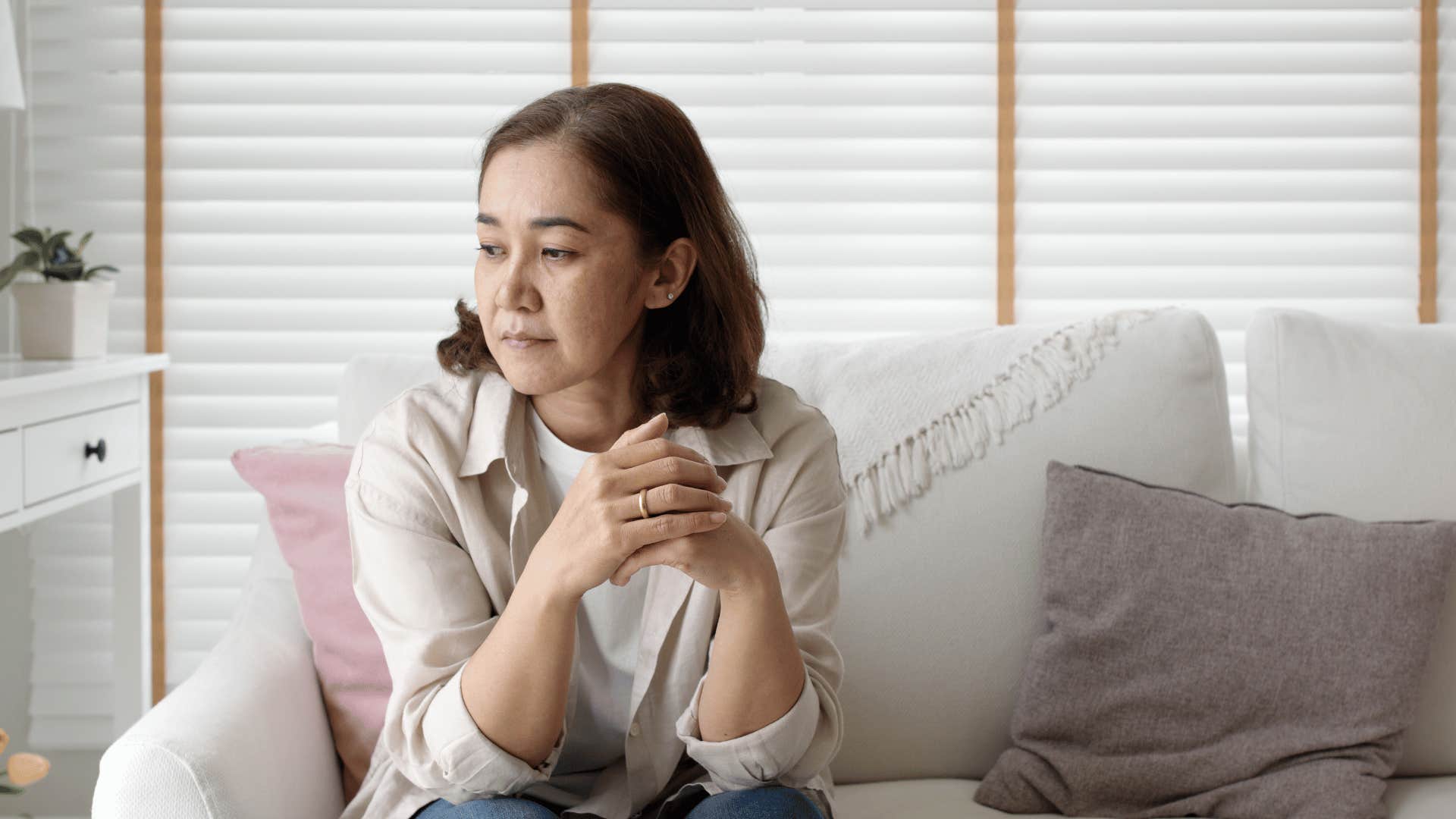
4. They're repeating patterns they experienced themselves
 Chay_Tee | Shutterstock
Generational trauma can deeply affect the way people relate to one another, both within their own family systems and outside of them. If a woman was treated poorly by her own mother-in-law, it's totally possible that she'll repeat that behavior with her kids' partners.
Because her relationship with her own mother-in-law was marked by disrespect, she saw only cold or demeaning behavior modeled as the way to show up in that particular role. She never learned the proper way to relate to her kids' partners and, as a result, she operates on the default mode of being a toxic mother-in-law.
5. They struggle with self-awareness
 Dima Berlin | Shutterstock
A lack of self-reflection can make it harder for some moms to adjust once their kids get married. She might subconsciously behave in ways that hurt her kids' partners or put them down, yet when her actions are brought to her attention, she denies them, rather than doing the internal work needed to show up differently in those relationships.
Psychologist Nick Wignall explained that "The best way to practice being more self-aware is to build habits that encourage it." These habits include being curious about how your own mind works and listening more than you speak.
Wignall also noted that people with a high level of self-awareness take feedback seriously, as they "Have the humility to understand that they can't always see themselves objectively." He shared that improving self-awareness requires people to tolerate the discomfort of receiving criticism, while doing the "work to avoid defensiveness at all costs."
A woman who doesn't exhibit self-reflective traits probably struggles to take negative feedback, which means she can't sit with what she's done wrong, let alone try to change her toxic mother-in-law behavior.
6. They feel unsettled when they're no longer the decision-maker
 Krakenimages.com | Shutterstock
When a mother feels unsettled about losing influence in her child's life, she may respond by becoming more controlling without realizing it. They expect everything to go their way, and they can't tolerate anyone deviating from their projected plan, which makes it hard to navigate any relationship.
As relationship and compatibility coach Deb Dutilh explained, exhibiting controlling behavior is a normal human response to feeling like you don't have agency in your own life. The need to feel a sense of control occurs when people feel "out of control, helpless, powerless, or hopeless."
Dutilh noted that one way to break free from control issues is to practice what she called "detached involvement," advising, "Quit taking things personally. Make no assumptions. Make as few judgments as possible. Say goodbye to the need to be right."
By letting go of the illusion that life is in our control, we give ourselves the gift of feeling free. While reprogramming oneself from having controlling tendencies isn't always easy, it's necessary to do so, especially for women who don't actually want to become toxic mothers-in-law.
7. They believe they know what's best for their child's life
 Krakenimages.com | Shutterstock
Being judgmental and critical of their kids' life choices is another trait a woman might display on her way to becoming a toxic mother-in-law. She might be a perfectionist who thinks she knows all the right answers and the correct way to do things.
This dynamic can become especially complicated if there are grandchildren involved. A woman who leans into toxic mother-in-law territory might criticize the way her grandkids are being raised. She might actively make decisions that go against what the parents want for their kids, such as ignoring their rules about food, routines, or screen time.
This behavior sets off a minefield of tension, pitting the mother-in-law against her child and their spouse. She might tone down her criticism, but still find ways to take subtle digs at her kid's partner, which is a sign that she's becoming a toxic mother-in-law.
8. They have a hard time letting go of the parenting role
 Ground Picture | Shutterstock
Being over-involved in their kids' lives is another indication that a woman is well on her way to being a toxic mother-in-law. This pattern of behavior can play out in a variety of ways. She might offer unsolicited advice, and then be offended when her kid and their spouse don't take it. She might expect constant communication or send nagging, non-stop texts at all hours.
If a woman inserts herself into her adult kids' lives, it's a clear sign that she's still attached to them on the same level as when they were actual children. She hasn't given them the space they need to establish their own independent lives, which can often signal trouble down the road, as she might become a toxic mother-in-law when her kids get married.
9. They feel like they’re losing their place in their child's life
 pics five | Shutterstock
For many moms, especially those who were deeply involved while their kids were growing up, becoming a mother-in-law can quietly feel like being pushed to the sidelines. One day, they're the person their child calls first about everything, and the next day, someone else fills that role. Even when they're happy their child has found love, that transformation can still sting.
Instead of recognizing that feeling as grief or adjustment, some moms react by holding on tighter. They may insert themselves into decisions, expect the same level of closeness as before, or subtly compete for attention. From their perspective, they're trying to stay connected.
But to their child's partner, it can feel like interference. And over time, that mismatch slowly turns into the kind of tension people associate with a toxic mother-in-law, even though it started from something very human: not wanting to feel replaced.
10. They built their identity around being a mom
 Gladskikh Tatiana | Shutterstock
Some women spend decades pouring their time, energy, and purpose into raising their children. So when those children grow up and start families of their own, it can leave them wondering where they fit now. That loss of role isn't something people talk about very often, but it's real.
A study published in the Journal of Family Psychology found that mothers who defined themselves primarily by their parenting role often had a harder time adjusting once their children became independent. When so much of someone's purpose has been tied to raising a child, it makes sense that stepping into the role of mother-in-law instead can feel less like a transition and more like a loss.
Instead of seeing their child's marriage as a natural next chapter, they may feel like something important is ending. That uncertainty can show up as criticism, overinvolvement, or difficulty respecting boundaries, especially if they're still adjusting to what their life looks like outside of parenting full-time.
It's not about wanting control as much as wanting reassurance that they still matter. But when that reassurance gets expressed through pressure or expectations, it can slowly veer their relationship with their child's partner in ways they never intended.
11. They're afraid of being left out as the family changes
 Krakenimages.com | Shutterstock
Marriage changes family dynamics, even in the healthiest households. Holidays get more stressful, traditions evolve, and decisions start to be made between the couple rather than by the wider family. For some moms, that transition feels less like growth and more like exclusion.
When they worry about losing access to their child or future grandchildren, they may try to stay involved in ways that feel protective to them but intrusive to everyone else. They might expect to be included in every plan, take changes personally, or react strongly when new routines no longer center them.
Underneath that behavior is often fear, not hostility. But if that fear goes unspoken, it can easily come across as controlling or dismissive, which is why even supportive moms sometimes end up being seen as a toxic mother-in-law without ever meaning to be.
Alexandra Blogier is a writer on YourTango's news and entertainment team. She covers social issues, pop culture analysis, and all things related to the entertainment industry.

